

Embryo Implantation Timeline: Symptoms, DPO & Calculator
Step-by-step guide to embryo implantation from fertilization to blastocyst attachment at 6-12 DPO, early implantation symptoms, spotting vs period, and calculator math.
Key Takeaways at a Glance
The Biological Journey: From Fertilization to Blastocyst Implantation
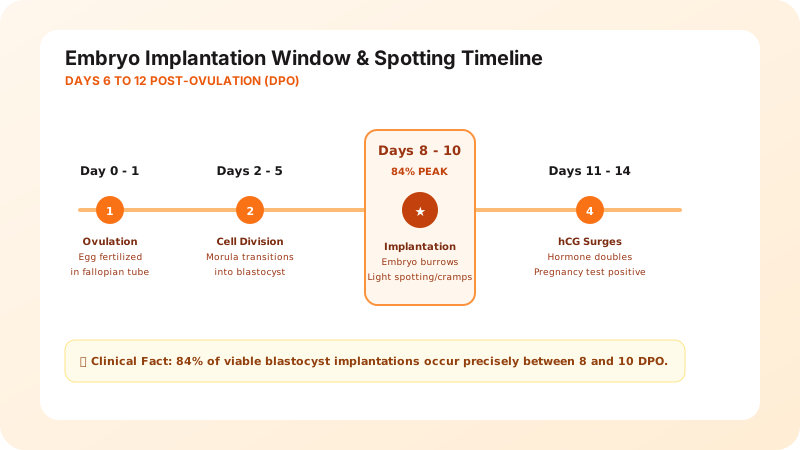
Conception is not an instantaneous single-moment event. After an ovulated egg is fertilized by sperm in the ampulla of the fallopian tube, the resulting zygote undergoes rapid mitotic division into a morula while migrating down the fallopian tube toward the uterus. By day 5 to 6 post-ovulation, the cellular cluster expands into a blastocyst consisting of an inner cell mass (the future fetus) and an outer trophoblast layer (the future placenta).
Key Checklist & Essential Facts
- Day 1 Post-Ovulation: Fertilization occurs in the fallopian tube
- Days 2 to 4: Cleavage stages (2-cell, 4-cell, 8-cell, and compact morula)
- Day 5: Blastocyst enters the uterine cavity and hatches from its protective zona pellucida shell
- Days 6 to 10: Trophoblast microvilli burrow into the receptive progesterone-primed endometrium
When Does Implantation Happen? The 6 to 12 DPO Window
Extensive clinical research published by Wilcox et al. (New England Journal of Medicine) demonstrates that 84% of successful implantations occur between 8 and 10 Days Past Ovulation (DPO). Implantation prior to 6 DPO or later than 12 DPO is biologically rare.
Key Checklist & Essential Facts
- 6 to 7 DPO: Early implantation window (less than 10% of conceptions)
- 8 to 10 DPO: Peak implantation window (84% of viable singleton pregnancies)
- 11 to 12 DPO: Late implantation window (higher risk of early biochemical pregnancy loss)
- Post-12 DPO: The uterine receptivity window closes as progesterone naturally begins to decline
Common Physical Symptoms of Implantation
As the blastocyst burrows into maternal endometrial capillary beds, subtle neurochemical and vascular reactions can produce observable physical symptoms.
Key Checklist & Essential Facts
- Implantation Cramping: Mild, dull tingling, pulling, or prickling sensations localized in the lower pelvis or one side, lasting 1 to 2 days
- Implantation Spotting: Scant pinkish or brownish discharge that does not fill a pad, occurring in 25-30% of women
- Basal Body Temperature Dip: A temporary 1-day dip in morning BBT around 7-10 DPO (the 'implantation dip') followed by sustained elevation
- Tender Swollen Breasts: Early estrogen and progesterone surges increase mammary blood flow
- Heightened Fatigue: Progesterone induces metabolic relaxation and drowsiness
Implantation Spotting vs. Early Period Bleeding: Key Distinctions
Distinguishing between implantation bleeding and an early menstrual period is vital for cycle tracking and conception timing.
Key Checklist & Essential Facts
- Color: Implantation bleeding is light pink or rusty brown; menstrual bleeding is bright crimson or dark red
- Flow: Implantation is scant spotting (a few drops or wiping residue only); periods flow continuously and require pads/tampons
- Clots: Implantation never produces clots or tissue chunks; menstrual flow frequently includes jelly-like coagulated clots
- Duration: Implantation spotting lasts a few hours up to 48 hours maximum; menstrual periods last 3 to 7 days
How to Calculate Your Implantation Window & Conception Date
Our free Implantation Calculator estimates your exact implantation timeline based on your last menstrual period (LMP) or confirmed ovulation date. Once implantation is complete, beta hCG enters the bloodstream, enabling positive pregnancy tests within 48 to 72 hours.
Key Checklist & Essential Facts
- Use our Ovulation Calculator to establish your baseline luteinizing hormone surge
- Allow at least 3 to 4 days after suspected implantation before taking a urine pregnancy test
- Track your symptoms and test results with complete on-device privacy in the Period Tracker app
Frequently Asked Questions
Clear, doctor-reviewed answers to common questions
On what day past ovulation (DPO) does implantation most commonly occur?+
How long does implantation bleeding last and what color is it?+
Can you feel implantation cramps, and where are they located?+
How many days after implantation will a pregnancy test turn positive?+
The health guides, cycle timelines, natural remedies, and symptom insights published on Period Tracker & Ovulation are strictly for general educational, self-tracking, and informational purposes. They are not a substitute for clinical advice, formal medical diagnosis, or personalized treatment plans. If you have severe pelvic discomfort, irregular bleeding, or questions about pregnancy, always consult with a licensed physician or gynecologist.
Recommended Health Guides
Continue reading certified guides in Pregnancy & Conception.


Conception, Ovulation & Implantation Authority Cluster
Verify fertile windows, blastocyst implantation timing, and basal body temperature shifts.