

How to Calculate Your Period Cycle Length Accurately: Step-by-Step Guide
Confused about how to count your menstrual cycle? Learn the exact golden rule: counting from Day 1 of one period to Day 1 of the next, avoiding common counting mistakes, and tracking variations.
Key Takeaways at a Glance
The Golden Rule: How to Count Your Cycle Days
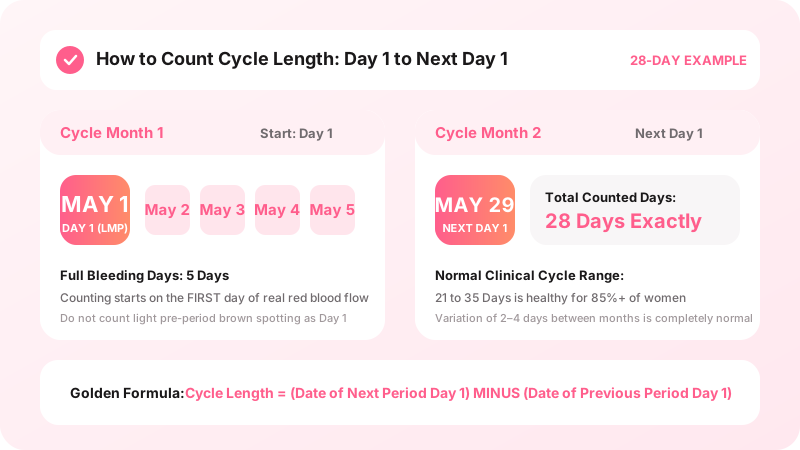
One of the most common mistakes people make when tracking their period is counting the days between when bleeding stops and when the next period starts. In medical science, your menstrual cycle is always calculated from Day 1 of one period (the very first day you see full red flow) up to, but not including, Day 1 of your next period. For instance, if your period starts on October 1st and your next period starts on October 29th, your cycle length is exactly 28 days.
Key Checklist & Essential Facts
- Day 1 is your first day of full, bright red bleeding (not light brown spotting)
- Count every single day up until the day before your next period begins
- If your period starts on May 1 and the next starts on May 29, your cycle is 28 days
What Is a Normal Cycle Length?
While 28 days is widely discussed as the textbook average, only about 15% of women experience exactly 28-day cycles. A normal, healthy menstrual cycle in adults can comfortably range anywhere from 21 to 35 days (and up to 45 days in teenagers whose hormones are still settling). As long as your cycle arrives within this window and is relatively predictable from month to month, your body is functioning healthily. You can use our free interactive Period Calculator to project your upcoming dates automatically.
Key Checklist & Essential Facts
- Short regular cycle: 21 to 24 days
- Average regular cycle: 25 to 30 days
- Long regular cycle: 31 to 35 days
- Normal monthly variation: Shifting by 2 to 4 days from one month to the next is completely normal
3 Common Counting Mistakes to Avoid
Getting inaccurate period predictions usually comes down to three simple misunderstandings. First, confusing pre-period brown spotting with Day 1: always wait until true red flow begins before marking Day 1. Second, counting from when bleeding ends: your bleeding duration (usually 3 to 7 days) is just the first part of your cycle, not a break between cycles. Third, assuming every month has 30 days: calendar months vary in length, which is why an automated tool or calendar count is essential.
Key Checklist & Essential Facts
- Mistake 1: Counting light pink or brown discharge as Day 1 instead of active red bleeding
- Mistake 2: Counting the days between bleeding episodes rather than start-to-start
- Mistake 3: Relying on memory instead of logging dates immediately in your period tracker
How to Handle Irregular Cycle Lengths
If your cycle lengths vary wildly—for example, 24 days one month, 42 days the next, and 30 days after that—you have what doctors classify as irregular periods. Irregular cycles make calendar-only math tricky because ovulation timing moves around. Tracking physical fertility signs, like egg-white cervical fluid and morning basal body temperature, gives you real-time clarity. You can also explore our Menstrual Cycle Calculator to see which phase your body is navigating.
Key Checklist & Essential Facts
- Log at least 3 to 6 consecutive cycles to calculate a reliable mathematical average
- Combine cycle counting with physical markers like cervical mucus changes and LH test strips
- If cycles are consistently longer than 35 days or shorter than 21 days, speak with a doctor to check for PCOS or thyroid imbalances
Frequently Asked Questions
Clear, doctor-reviewed answers to common questions
Does cycle length count the days you bleed?+
Is a 26-day or 32-day cycle normal?+
How do I calculate cycle length if my period is irregular?+
Why is my cycle length different every month?+
The health guides, cycle timelines, natural remedies, and symptom insights published on Period Tracker & Ovulation are strictly for general educational, self-tracking, and informational purposes. They are not a substitute for clinical advice, formal medical diagnosis, or personalized treatment plans. If you have severe pelvic discomfort, irregular bleeding, or questions about pregnancy, always consult with a licensed physician or gynecologist.
Recommended Health Guides
Continue reading certified guides in Period & Menstrual Cycle.



Menstrual Cycle Health, Safe Days & Flow Diagnostics
Understand menstrual blood clot dimensions, natural family planning safe days, and cycle lengths.