

Spotting vs Period: 5 Clear Ways to Tell the Difference
Not sure if you are spotting or starting your period? Learn the 5 key differences in color, flow volume, duration, and cramping, and find out if it could be implantation bleeding.
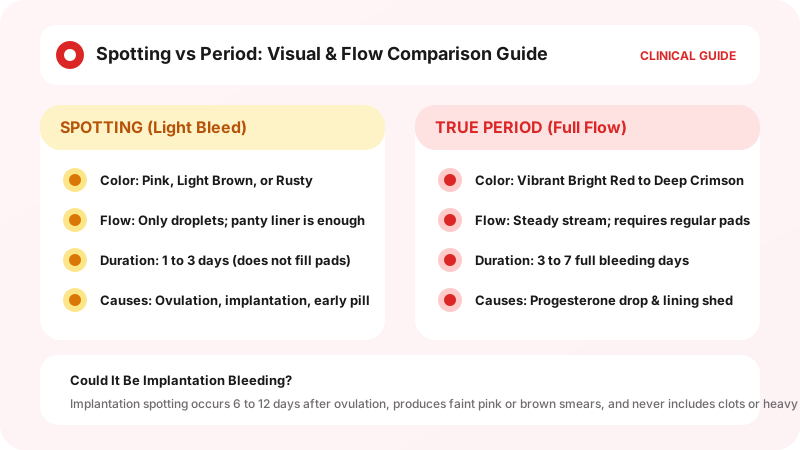
Key Takeaways at a Glance
Why Bleeding Can Be Confusing
Seeing unexpected blood in your underwear or on toilet paper can leave you wondering: 'Is my period starting early, or am I just spotting?' While both involve vaginal bleeding, the biological causes, flow characteristics, and clinical meanings are very different. Understanding whether your bleeding is light spotting or a true period helps you track your cycle accurately, avoid false pregnancy alarms, or catch early conception right on time.
Key Checklist & Essential Facts
- Spotting is light, sporadic bleeding that does not fill a pad or tampon
- A true period is the full monthly shedding of the uterine lining with steady red flow
- Spotting can occur during ovulation, early pregnancy implantation, or hormonal shifts
The 5 Key Differences: Spotting vs True Period
Here is how to tell them apart using five simple observations:
Key Checklist & Essential Facts
- 1. Color of the Blood: Spotting is usually light pink, peachy, or dark brown (oxidized blood that took longer to leave the uterus). A real period is vibrant crimson or dark red.
- 2. Volume and Flow: Spotting produces tiny droplets or streaks that only require a panty liner. A true period flows steadily, requiring regular pads, tampons, or a menstrual cup.
- 3. Duration of Bleeding: Spotting lasts anywhere from a few hours up to 1 to 3 days maximum. A normal period lasts 3 to 7 full bleeding days.
- 4. Presence of Clots: Spotting never contains jelly-like clots or tissue pieces. True periods frequently feature small endometrial blood clots, especially on heavy days.
- 5. Cramping Intensity: Spotting is usually painless or accompanied by very faint lower pelvic twinges. Periods bring noticeable, rhythmic uterine cramps driven by prostaglandins.
Could It Be Implantation Bleeding?
If you had unprotected sex around your fertile window and notice faint spotting about a week before your expected period, it could be implantation bleeding. When a fertilized blastocyst burrows into the rich uterine lining (usually 6 to 12 days after ovulation), tiny capillaries can break, causing brief pink or light brown smears. Implantation bleeding is light, lasts 24 to 48 hours, and never develops into a heavy red flow. Use our Implantation Calculator to check your timeline.
Key Checklist & Essential Facts
- Timing: Happens roughly 6 to 12 days post-ovulation (DPO), just before your missed period
- Appearance: Very light pink or brown droplets; never bright red with clots
- Confirmation: If you suspect implantation, take a home pregnancy test on the day your period is due
Other Common Causes of Mid-Cycle Spotting
Spotting isn't always related to pregnancy. Other benign triggers include ovulation spotting (a harmless drop of blood when the follicle ruptures mid-cycle), starting or missing birth control pills, rough intercourse, or cervical irritation from a Pap smear. However, persistent spotting between cycles or bleeding after menopause should always be evaluated by a doctor to rule out polyps, fibroids, or infections.
Key Checklist & Essential Facts
- Ovulation spotting: A tiny droplet around Day 14 caused by an estrogen dip
- Hormonal contraceptives: Breakthrough spotting is very common during the first 3 months of a new pill or IUD
- Cervical friction: Light spotting after intimacy is common and usually stems from sensitive cervical tissue
- Check cycle patterns using our Menstrual Cycle Calculator
Frequently Asked Questions
Clear, doctor-reviewed answers to common questions
Can spotting turn into a full period?+
How do I know if bleeding is implantation or my period?+
Is brown blood always old blood?+
When should I see a doctor for spotting?+
The health guides, cycle timelines, natural remedies, and symptom insights published on Period Tracker & Ovulation are strictly for general educational, self-tracking, and informational purposes. They are not a substitute for clinical advice, formal medical diagnosis, or personalized treatment plans. If you have severe pelvic discomfort, irregular bleeding, or questions about pregnancy, always consult with a licensed physician or gynecologist.
Recommended Health Guides
Continue reading certified guides in Getting Pregnant & Pregnancy.

Early Pregnancy, hCG Velocity & Gestational Health
Monitor beta hCG doubling velocities, pregnancy test timelines, and gestational week benchmarks.