

When to Take a Pregnancy Test: DPO Accuracy & Timing Guide
Discover the most accurate day to take a home pregnancy test based on Days Past Ovulation (DPO), test sensitivity (10 mIU vs 25 mIU), and avoiding false negatives.
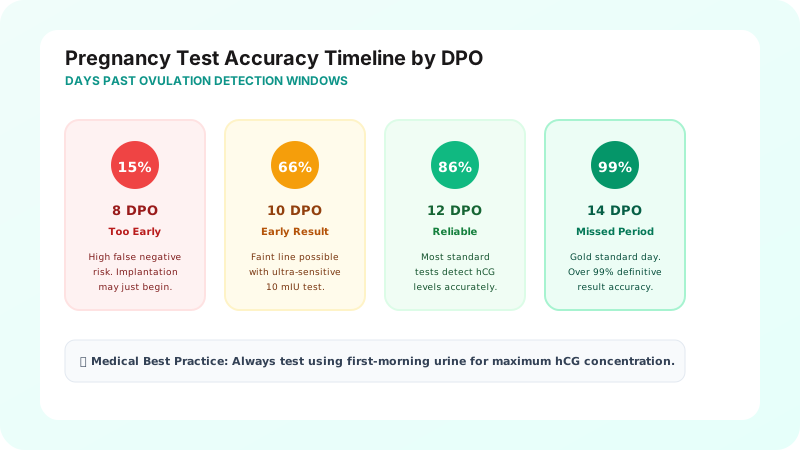
Key Takeaways at a Glance
How Early Can You Take a Pregnancy Test? The Biology of DPO
Taking a home pregnancy test too early is the single most common cause of emotional distress and false-negative results. A pregnancy test cannot detect pregnancy at fertilization. It detects human Chorionic Gonadotropin (hCG), which only begins entering the maternal bloodstream after the embryo implants into the uterine lining—typically occurring between 8 and 10 Days Past Ovulation (DPO).
Key Checklist & Essential Facts
- Conception occurs within 24 hours of ovulation, but implantation takes an additional 6 to 10 days
- hCG is secreted into maternal blood within 24-48 hours after blastocyst attachment
- Urine hCG levels trail blood serum concentrations by approximately 24 hours
DPO Pregnancy Test Accuracy Timeline: Day by Day (8 DPO to 14 DPO)
Clinical studies tracking sensitive urine pregnancy tests demonstrate a steep accuracy curve as Days Past Ovulation progress.
Key Checklist & Essential Facts
- 8 DPO (33% Accuracy): Earliest possible positive; high false-negative risk as most embryos have not yet completed implantation
- 9 DPO (52% Accuracy): Implantation has occurred in roughly half of viable pregnancies; faint shadow or squinter line may appear
- 10 DPO (74% Accuracy): Faint but discernible positive line on sensitive 10 mIU/mL early detection tests
- 11 DPO (84% Accuracy): Solid test line visible; false negative rate drops below 16%
- 12 DPO (93% Accuracy): High reliability; most pregnant women achieve unambiguous positive test lines
- 14 DPO / Missed Period (99% Accuracy): Gold standard for maximum diagnostic reliability across all test brands
Test Sensitivity: 10 mIU/mL Early Detection vs. 25 mIU/mL Standard Tests
Home pregnancy tests differ significantly in analytical sensitivity. 'Early Result' tests detect hCG concentrations as low as 10 mIU/mL, enabling detection up to 5 to 6 days before a missed period. Standard rapid-response strips require 25 mIU/mL or higher, meaning testing before 12-14 DPO often yields negative results despite viable conception.
Key Checklist & Essential Facts
- Ultra-sensitive tests (10 mIU/mL): Suitable for 10 to 12 DPO testing with first morning urine
- Standard tests (25 mIU/mL): Reliable from 13 to 14 DPO onward
- Digital tests: Require 25 to 50 mIU/mL; recommended only after a confirmed missed period
Evaporation Lines vs. Faint Positive Lines: How to Tell
A true positive line contains pink or blue dye and develops within the test's designated reaction window (typically 3 to 5 minutes). An evaporation line is a colorless, grayish phantom shadow that appears after the urine has completely dried, caused by urine residue passing over the antibody strip.
Key Checklist & Essential Facts
- True Positive: Displays visible pigment (pink or blue), appears within 3-5 minutes, and darkens over 48 hours
- Evaporation Line: Colorless, gray, or translucent; appears after 10-15 minutes as the test dries
- Rule of thumb: Always discard and ignore test results after the 10-minute validity window
Calculate Your Optimal Testing Date with Our Free Tool
Instead of guessing when to test and wasting expensive test kits, use our free Pregnancy Test Calculator. By entering your last period date or confirmed ovulation day, the algorithm computes your exact 10 DPO, 12 DPO, and 14 DPO testing milestones for 99% accuracy.
Key Checklist & Essential Facts
- Always test with first-morning urine, which holds the highest concentration of hCG
- Avoid excessive fluid intake before testing to prevent urine dilution
- Cross-reference results with our Implantation Calculator and Ovulation Calculator
Frequently Asked Questions
Clear, doctor-reviewed answers to common questions
Can a pregnancy test be positive at 8 DPO?+
Why is morning urine best for early pregnancy testing?+
Can I get a false negative if I test before my missed period?+
What does a very faint line on a pregnancy test mean?+
The health guides, cycle timelines, natural remedies, and symptom insights published on Period Tracker & Ovulation are strictly for general educational, self-tracking, and informational purposes. They are not a substitute for clinical advice, formal medical diagnosis, or personalized treatment plans. If you have severe pelvic discomfort, irregular bleeding, or questions about pregnancy, always consult with a licensed physician or gynecologist.
Recommended Health Guides
Continue reading certified guides in Pregnancy & Conception.



Early Pregnancy, hCG Velocity & Gestational Health
Monitor beta hCG doubling velocities, pregnancy test timelines, and gestational week benchmarks.