

hCG Levels Chart by Week & Doubling Time Calculator Guide
Complete medical guide to beta hCG levels by week of pregnancy, normal 48-72 hour doubling time math, what slow-rising or high hCG means, and how to use our free hCG calculator.
Key Takeaways at a Glance
What is Human Chorionic Gonadotropin (Beta hCG)?
Human Chorionic Gonadotropin (hCG) is a peptide hormone produced primarily by the syncytiotrophoblast cells of the developing embryo following implantation. It signals the corpus luteum inside the ovary to continue secreting progesterone, preventing menstruation and maintaining the thick endometrial lining essential for sustaining the pregnancy.
Key Checklist & Essential Facts
- Detectable in maternal blood as early as 8 to 11 days post-ovulation (DPO)
- Detectable in home urine pregnancy tests around 12 to 14 DPO
- Qualitative tests provide a yes/no answer; Quantitative (Beta hCG) tests measure exact mIU/mL concentration
Normal hCG Reference Range by Week of Pregnancy (LMP)
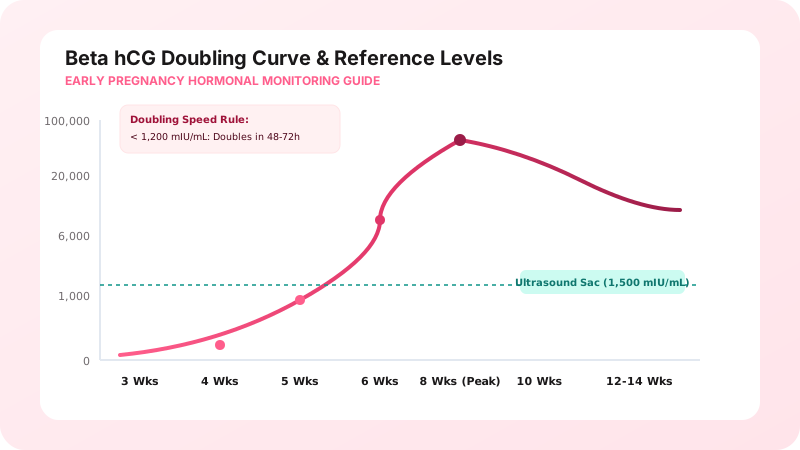
hCG concentrations vary widely between individuals. Clinical diagnostics focus on the rate of rise rather than an isolated baseline figure. In early viable singleton pregnancies with hCG below 1,200 mIU/mL, levels typically double every 48 to 72 hours.
Key Checklist & Essential Facts
- 3 Weeks Gestational Age (1 Week Post-Conception): 5 – 50 mIU/mL
- 4 Weeks Gestational Age (Expected Period Day): 10 – 426 mIU/mL
- 5 Weeks Gestational Age: 18 – 7,340 mIU/mL
- 6 Weeks Gestational Age: 1,080 – 56,500 mIU/mL
- 7 – 8 Weeks Gestational Age: 7,650 – 229,000 mIU/mL
- 9 – 12 Weeks (Peak Level): 25,700 – 288,000 mIU/mL
hCG Doubling Time Math: What 48 to 72-Hour Rates Indicate
The mathematical formula for calculating beta hCG doubling time uses natural logarithms: Doubling Time = (Time Elapsed in Hours × ln(2)) / (ln(Second hCG) - ln(First hCG)). A normal doubling rate during the first 4 to 6 weeks is between 48 and 72 hours, corresponding to a minimum 35% to 53% increase over 48 hours.
Key Checklist & Essential Facts
- Under 1,200 mIU/mL: Doubling time is normally between 48 and 72 hours
- 1,200 to 6,000 mIU/mL: Doubling slows to between 72 and 96 hours
- Above 6,000 mIU/mL: Doubling typically takes 96 hours or more
- After 10 to 12 weeks: hCG naturally plateaus and gradually decreases for the remainder of pregnancy
Slow-Rising vs. Abnormally High hCG Levels: Clinical Significance
Deviations from standard doubling curves warrant serial ultrasound and endocrinological evaluation. A single low reading does not imply complication, but persistent plateaus or declines before 8 weeks are clinical markers.
Key Checklist & Essential Facts
- Slow-Rising hCG (Doubling > 96 hrs early on): May indicate an ectopic pregnancy, blighted ovum, or imminent early pregnancy loss
- Abnormally High or Rapid Doubling hCG: May indicate twin or triplet gestation, incorrect dating, or gestational trophoblastic disease (molar pregnancy)
- Discriminatory Zone: When quantitative serum hCG surpasses 1,500 to 2,000 mIU/mL, a gestational sac should be identifiable via transvaginal ultrasound
How to Accurately Track Doubling in Our Free Tool
Our online Beta hCG Doubling Calculator calculates your exact doubling time in hours, 48-hour percentage increase, and projected 72-hour levels based on two successive lab draws. Track your dates and values alongside our free Ovulation Calculator and Due Date Calculator for complete clinical clarity.
Key Checklist & Essential Facts
- Draw both blood tests at the same laboratory when possible for consistent assay calibration
- Ensure at least 48 hours elapse between blood draws for accurate mathematical velocity
- Store your blood lab values with end-to-end local privacy inside the Period Tracker app
Frequently Asked Questions
Clear, doctor-reviewed answers to common questions
What is a normal hCG doubling time in early pregnancy?+
Does slow rising hCG always mean a miscarriage or ectopic pregnancy?+
Can hCG levels double faster than 48 hours with twins?+
At what hCG level should an embryo be visible on ultrasound?+
The health guides, cycle timelines, natural remedies, and symptom insights published on Period Tracker & Ovulation are strictly for general educational, self-tracking, and informational purposes. They are not a substitute for clinical advice, formal medical diagnosis, or personalized treatment plans. If you have severe pelvic discomfort, irregular bleeding, or questions about pregnancy, always consult with a licensed physician or gynecologist.
Recommended Health Guides
Continue reading certified guides in Pregnancy & Conception.



Early Pregnancy, hCG Velocity & Gestational Health
Monitor beta hCG doubling velocities, pregnancy test timelines, and gestational week benchmarks.