

Cervical position during ovulation vs early pregnancy: the SHOW guide
Master the SHOW method (Soft, High, Open, Wet) to check your cervical position throughout your cycle to identify peak ovulation and early pregnancy changes.
Key Takeaways at a Glance
The SHOW Rule: What Your Cervix Feels Like During Peak Fertility
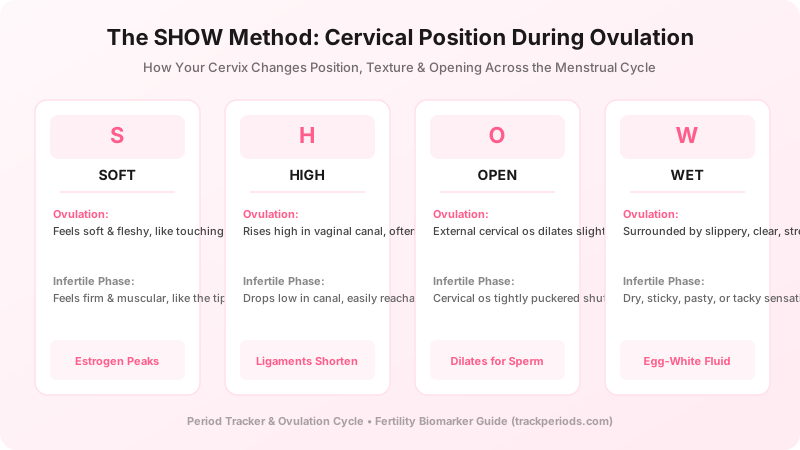
Your cervix is the cylinder-shaped neck of tissue that connects your vagina to your uterus. Under the influence of surging estrogen leading up to ovulation, the cervix undergoes dramatic physical remodeling remembered by the medical acronym SHOW: Soft, High, Open, and Wet.
Key Checklist & Essential Facts
- S - Soft: Feels plush and yielding like your lower lips or an earlobe, rather than firm cartilage
- H - High: Rises deep into the upper vaginal vault as uterine ligaments contract, often making it difficult to reach with a single finger
- O - Open: The central dimple (external os) dilates slightly to permit microscopic sperm passage into the fallopian tubes
- W - Wet: Abundant, lubricative, clear egg-white cervical fluid coats the cervical entrance
Step-by-Step Hygienic Guide to Checking Your Cervical Position
Checking your cervix is safe and straightforward once you learn proper technique. Consistency is key: check at the same time each day, preferably after showering or before bedtime, and avoid checking right after sexual intercourse.
Key Checklist & Essential Facts
- Hygiene First: Thoroughly wash your hands with mild, unscented soap and ensure fingernails are neatly trimmed to avoid mucosal micro-abrasions
- Choose a Consistent Posture: Squatting low, sitting on the toilet with knees apart, or propping one foot up on a bathtub rim offers optimal pelvic angle
- Gentle Exploration: Slowly insert your clean middle finger into the vaginal canal, aiming toward your lower back until you encounter a round, donut-shaped mound with a central depression
- Assess Texture & Height: Note whether it feels firm like the tip of your nose (infertile) or soft like your lips (fertile), and how deeply your finger had to reach
Cervical Position in Early Pregnancy vs. Pre-Menstrual Drop
After ovulation, progesterone causes the cervix to quickly become low, firm, dry, and tightly closed. But what happens if fertilization and implantation occur? In early pregnancy, as progesterone and hCG sustain the uterine lining, the cervix typically remains relatively high, soft, and tightly sealed by a thick protective cervical mucus plug (operculum). However, cervical position alone is not a definitive pregnancy test; verify with a sensitive home pregnancy test.
Key Checklist & Essential Facts
- Pre-Menstrual Drop: If not pregnant, the cervix drops lower into the canal, hardens like nose cartilage, and dilates slightly to let menstrual blood drain
- Early Pregnancy Position: Stays elevated, soft to the touch, and firmly puckered shut to safeguard the embryonic environment
- Variability Caveat: Cervical height fluctuates throughout the day with bladder fullness and bowel movements; never rely solely on cervix checks for pregnancy confirmation
Pairing Cervix Checks with BBT & Cervical Mucus for Tri-Biomarker Accuracy
The most effective natural family planning and conception protocol is the Symptothermal Method. By cross-referencing your cervix firmness with our cervical mucus stages guide and daily basal body temperature tracking, you capture both the opening of your fertile window (via SHOW) and the confirmation of ovulation (via the 3-over-6 BBT thermal rise).
Key Checklist & Essential Facts
- Opening the Window: Cervix softens and egg-white mucus emerges 3 to 5 days before ovulation
- Peak Day: Cervix reaches maximum height and openness on the day of peak luteinizing hormone (LH)
- Closing the Window: Sustained 0.4°F to 0.8°F thermal shift for 3 consecutive days confirms progesterone release and infertile status
Frequently Asked Questions
Clear, doctor-reviewed answers to common questions
What does a high, soft, open cervix mean?+
Does your cervix feel high or low in early pregnancy?+
Can checking your cervix cause an infection or early miscarriage?+
How long after ovulation does the cervix drop and harden?+
The health guides, cycle timelines, natural remedies, and symptom insights published on Period Tracker & Ovulation are strictly for general educational, self-tracking, and informational purposes. They are not a substitute for clinical advice, formal medical diagnosis, or personalized treatment plans. If you have severe pelvic discomfort, irregular bleeding, or questions about pregnancy, always consult with a licensed physician or gynecologist.
Recommended Health Guides
Continue reading certified guides in Fertility.


Menstrual Cycle Health, Safe Days & Flow Diagnostics
Understand menstrual blood clot dimensions, natural family planning safe days, and cycle lengths.