

Due date by conception date vs LMP: how to calculate exact due date
Learn the biological and mathematical differences between calculating your estimated due date (EDD) by exact conception date (266 days) vs. your last menstrual period (280 days).
Key Takeaways at a Glance
The 280-Day Rule vs. The 266-Day Biological Reality
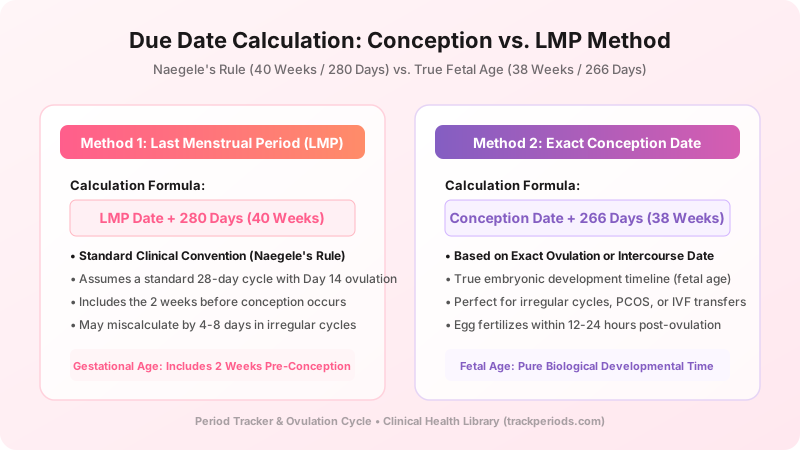
When you confirm a positive pregnancy test, most doctors calculate your Estimated Due Date (EDD) using Naegele’s Rule: adding 280 days (40 full weeks) to the first day of your Last Menstrual Period (LMP). However, conception does not happen on day one of your period. Biologically, fertilization occurs approximately 14 days later during ovulation. If you know your ovulation day or exact intercourse timing, calculating from your conception date requires adding 266 days (38 weeks), reflecting true fetal embryonic age.
Key Checklist & Essential Facts
- LMP Calculation (Gestational Age): LMP + 280 days (40 weeks) — includes the 2 weeks before you actually conceived
- Conception Calculation (Fetal Age): Conception Date + 266 days (38 weeks) — true biological age of the developing fetus
- The 14-Day Discrepancy: Assumes a textbook 28-day cycle; women with longer or irregular cycles may experience significant LMP calculation errors
Why Pinpointing the Exact Day of Conception Is Tricky
Many people assume conception happens the exact hour of intercourse, but human biology is more flexible. Sperm can survive inside fertile cervical mucus for up to 5 days, whereas an ovulated egg remains viable for only 12 to 24 hours. If you had sex on Monday and ovulated on Thursday, fertilization happened on Thursday or Friday—meaning your biological conception date is 3 to 4 days after intimacy.
Key Checklist & Essential Facts
- Sperm Viability Window: 72 to 120 hours in alkaline fertile cervical fluid
- Egg Viability Window: 12 to 24 hours post-follicular rupture
- Conception Date Window: Can occur any time between the day of intercourse and up to 5 days later
Calculating Due Date by Implantation Date & Early Ultrasound
For women tracking luteal phase milestones, implantation takes place between 6 and 12 Days Past Ovulation (DPO), with 84% occurring between 8 and 10 DPO. You can cross-reference our implantation timeline and calculator guide to trace blastocyst burrowing. In clinical practice, an early first-trimester ultrasound measuring Crown-Rump Length (CRL) between 7 and 12 weeks provides the gold standard dating accuracy within 3 to 5 days.
Key Checklist & Essential Facts
- Implantation Window: 8-10 DPO on average; beta hCG enters maternal bloodstream 48 hours later
- Crown-Rump Length (CRL): Most accurate ultrasound measurement before biological growth variations appear in second trimester
- EDD Adjustment Criteria: Clinicians typically update your due date only if ultrasound dating differs from LMP by more than 7 days
IVF Due Date Formulas: Day 3 vs. Day 5 Blastocyst Transfers
For in vitro fertilization (IVF) pregnancies, conception timing is scientifically exact. Rather than estimating ovulation, reproductive endocrinologists date pregnancies using the precise date of embryo transfer and the embryo’s developmental stage at transfer.
Key Checklist & Essential Facts
- Day 3 Embryo Transfer Formula: Transfer Date + 263 days (or Transfer Date - 3 days + 266 days)
- Day 5 Blastocyst Transfer Formula: Transfer Date + 261 days (or Transfer Date - 5 days + 266 days)
- Frozen Embryo Transfer (FET): Follows the identical formula based on embryo age at freeze
How to Use Our Digital Pregnancy Due Date Tools
Whether you have regular cycles, irregular PCOS cycles, or tracked ovulation with basal body temperature (BBT), you can test your personal milestones with our interactive pregnancy due date calculator and implantation calculator. Both tools run 100% locally on your browser with zero private health data transmitted.
Key Checklist & Essential Facts
- Calculate by LMP, Conception Date, or Average Cycle Length
- Generates your trimester milestones, fetal growth comparisons, and safe testing dates
- Cross-checks with your logged ovulation calculator results
Frequently Asked Questions
Clear, doctor-reviewed answers to common questions
Is due date by conception more accurate than due date by LMP?+
How many days do you add to conception date to get your due date?+
Can an ultrasound change my due date?+
What percentage of babies are actually born on their exact due date?+
The health guides, cycle timelines, natural remedies, and symptom insights published on Period Tracker & Ovulation are strictly for general educational, self-tracking, and informational purposes. They are not a substitute for clinical advice, formal medical diagnosis, or personalized treatment plans. If you have severe pelvic discomfort, irregular bleeding, or questions about pregnancy, always consult with a licensed physician or gynecologist.
Recommended Health Guides
Continue reading certified guides in Pregnancy.



Early Pregnancy, hCG Velocity & Gestational Health
Monitor beta hCG doubling velocities, pregnancy test timelines, and gestational week benchmarks.